Friday, February 26, 2010

Wat Pho or Wat Phra Chetuphon


       Wat Pho or Wat Phra Chetuphon as it is generally known to the Thais, is mainly famous for the huge Reclining Buddha statue it houses. At 20 acres large, it is the largest Wat in Bangkok, and is technically the oldest too, as it was built around 200 years before Bangkok became Thailand's capital. However, today the Wat today bears virtually no resemblance to that originally constructed, as it was almost entirely rebuilt by Rama I when the capital was moved to Bangkok. It holds the dual honors of having both Thailand's largest reclining Buddha image and the most number of Buddha images in Thailand.
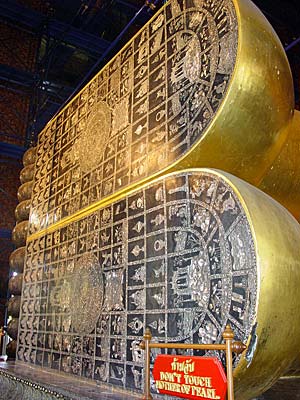


       The highly impressive gold plated reclining Buddha is 46 meters long and 15 meters high, and is designed to illustrate the passing of the Buddha into nirvana. The feet and the eyes are engraved with mother-of-pearl decoration, and the feet also show the 108 auspicious characteristics of the true Buddha.


        The large grounds of Wat Pho contain more than 1000 Buddha images in total, most from the ruins of the former capitals Ayuthaya and Sukhothai. The grounds are split in two by Chetuphon road. The northern section is generally the only one most people go to, and it includes a large bot (temple hall), enclosed by 394 bronze Buddha images. Outside the bot, there are 152 marble slabs depicting the second half of the epic Ramakian story.


         Also near here are four chedis, constructed to honor the first three Chakri kings (two for King Rama III). There are also a massive 91 others Chedis of varying sizes arounds the grounds, along with chapels, rock gardens, an array of different types of statues, inscriptions, belltowers and resident fortune tellers.

        The library is nearby too, decorated impressively with figures and pagodas made of porcelain, in much the same way as Wat Arun across the river. The much less visited southern section has less of interest, but makes a good place to find a monk to chat to for a while. Most would welcome the chance to practice their English on visitors.


http://www.into-asia.com/

Beautiful in 'Krabi'


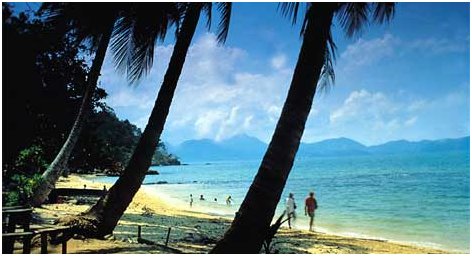
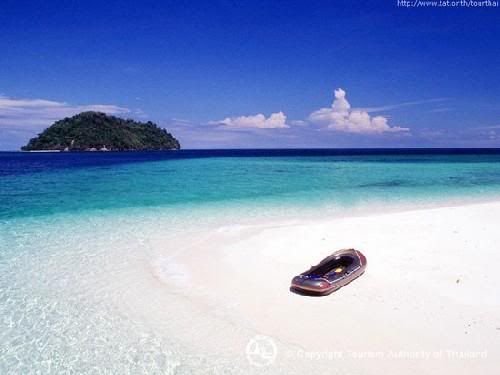
      Krabi is situated on the south of Thailand. West of Krabi is the Andaman Sea. Krabi is abundant of sea- natural attractions. Find more Krabi geography. Koh Phi Phi seems to be more known than Krabi. Many international movies were made at Koh Phi Phi e.g. the Beach.


       To arrive at Krabi is very easy nowadays. You may fly, take a bus or train but stop at Suratthani, or even ferry boat from Phuket. Find how to get to Krabi.

       What are interesting places for a tourist like me?

       In addition to Koh Phi Phi, Ao Nang, Koh Lanta and Railay are well-known among European tourists. Recently, Tupkaek beach is gaining more popularity for tourists who would like to avoid the crowd from Ao Nang. Find more Krabi Attractions.

      What are we going to do in Krabi?

       Krabi is a popular place for sea kayaking at Tha Lane, Khao Nor Ju Jee, Koh Hong , Pranang Cave, Koh Phak Bia, etc. Rock climbing must be at Railay. Scuba diving and snorkeling at Koh Phi Phi or Koh Ngai or Koh Rok (near Koh Lanta). Find more activities in Krabi.

   
      How about nightlife in Krabi?

       Only food market, so called Talad Torung in Krabi Town, around Chao Fah road. You may find a local food with very cheap price from half hundred food shops. Unlike Aonang, you may find international food restaurants till the mid night. Phi Phi is a never sleeping spot, mostly found are beer bars. On the other islands e.g. Koh Ngai, Koh Mook, Koh Jum, Koh Libing, you won’t find any nightlife.


      Where will I sleep?

         There are many budget guesthouses to luxury hotels in all Krabi province. For anyone who would travel to the islands you have to book a room for at least 1 to 6 months in advance. Some destinations have only limited numbers of rooms and resorts e.g. Railay, Koh Mook and Koh Ngai.

         You may need to sleep on the beach unless you book in advance, especially during the high season: November to March every year. In Krabi town, you may find accommodation easilier if you walk around Chaofah Road. At Aonang, there are many newly open resorts and bungalows in sub-roads. You may hire songtaew (passenger pick-up car) or Tuk-Tuk and the driver will bring you around for accommodation.


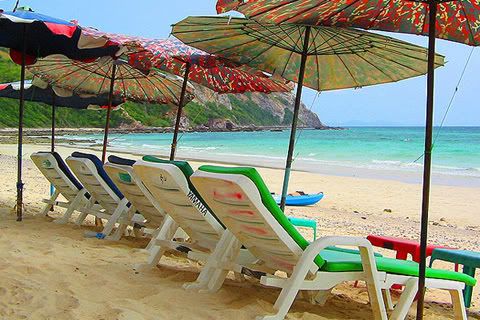
Pattaya beach


        Pattaya is a popular tourist resort on the North Gulf Coast of Eastern Thailand, located 150 km south-east of Bangkok. Pattaya is most famous for its go-go and beer bars, but local authorities has made efforts to provide more family-friendly attractions and activities, and specialist conference and golfing facilities. Although the sex industry is still going strong in Pattaya,

       the resort also attracts local families and holidaymakers from far and wide. Efforts by the local authorities over the past few years have improved the quality of the beaches, but they are still lacklustre by Thailand's high standards, and over-development has long since destroyed some of the natural charms the area once had. However, the plethora of hotels and guest houses, and easy access from the capital and airport, make it a popular weekend getaway.

       Catering for over five million tourists yearly, Pattaya is also able to offer an excellent range of eating choices and a wide variety of things to do and see. Its population is a colorful mix of nationalities and ethnicities from near and far.


        "Greater Pattaya" occupies most of the coastline of Banglamung (one of the eleven districts that comprise Chonburi Province . It is divided into a larger northern section which spans the areas to the east of Naklua Beach (the most northern beach) and Pattaya Beach (the main beach) plus the Buddha Hill headland (immediately south of Pattaya Beach), and a smaller southern section covering the area to the east of Jomtien Beach (which lies directly south of Buddha Hill) including Dongtan Beach. Jomtien's beaches are much broader and generally in better shape, and the atmosphere locally is more sedate and family-oriented, than at Pattaya Beach.


        North Pattaya (Pattaya Nua) - not the northern-most part of Pattaya (as Naklua lies further north), but the section of Pattaya adjacent to the northern end of Pattaya Beach and extending inland to both the north and south of North Pattaya Road. Does not include Naklua.

       South Pattaya (Pattaya Tai) - not the southern-most part of Pattaya (as the Buddha Hill headland, and then Jomtien, lie further south), but the section of Pattaya adjacent to the southern end of Pattaya Beach and extending inland to both the north and south of South Pattaya Road. Includes Pattayaland and Walking Street. Does not include Buddha Hill or Jomtien.

      Central Pattaya (Pattaya Klang) - not the dead center of Pattaya, but the section of Pattaya adjacent to the middle of Pattaya Beach and extending inland to both the north and south of Central Pattaya Road. Some maps/guides disregard the Central Pattaya convention, and instead extend North Pattaya and South Pattaya to meet each other along Central Pattaya Road; sometimes, Beach Road is described with a similar division, and the respective halves given "North Beach Road" and "South Beach Road" monikers.


      From bars and stores and stretches out to the beaches. Jomtien Beach the watersport center South of Pattaya is, a seven-kilometer stretch popular with windsurfers and watersports enthusiasts. Jomtien, in fact, is the windsurfing capital of the country, thanks other things, including massage. Swimming is a popular activity on Jomtien Beach. The water here is a little deeper than that


       Boasts an incredible choice of accommodation to suit every pocket. Facilities range from with private beaches to and inland, and. Pattaya has accommodation to suit all budgets and preferences, and for whatever the duration. There is long-term accommodation in the form of lease or rent, A relatively new concept has reached Pattaya


Wat Phra Kaew.


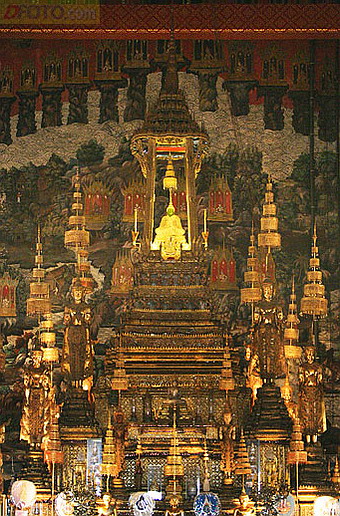
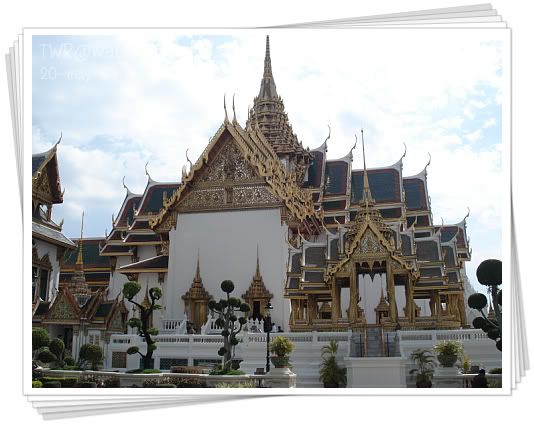
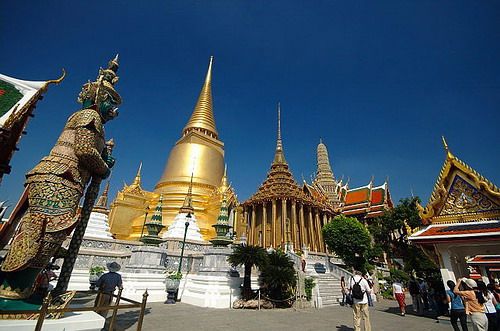
      The Wat Phra Kaew (English Temple of the Emerald Buddha, Thai: วัดพระแก้ว; full official name Wat Phra Sri Rattana Satsadaram, Thai: วัดพระศรีรัตนศาสดาราม) is regarded as the most sacred Buddhist temple (wat) in Thailand. It is located in the historic center of Bangkok (district Phra Nakhon), within the grounds of the Grand Palace.

      The construction of the temple started when King Buddha Yodfa Chulaloke (Rama I) moved the capital from Thonburi to Bangkok in 1785. Unlike other temples it does not contain living quarters for monks; rather, it has only the highly decorated holy buildings, statues, and pagodas.

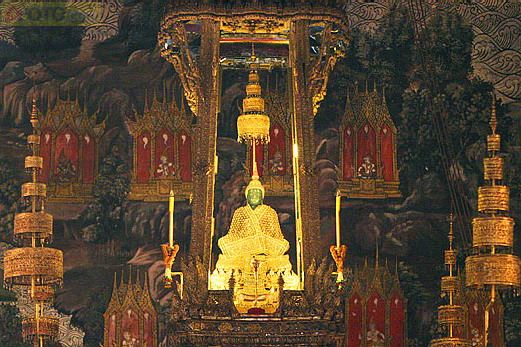
      The main building is the central ubosoth, which houses the Emerald Buddha. There are three main doors used to enter the temple, however only the King and Queen are allowed to enter through the center door. Even though it is small in size it is the most important icon for Thai people. Legends hold that the statue originated in India, but it first surfaced in the vassal Kingdom of Cambodia and was given as a gift to the King of Ayuttaya in the 15th century 1434.
   
      The image disappeared when Burmese raiders sacked Ayuttaya and the image was feared lost. A century later, the 'Emerald' Buddha reappeared in Chiang Saen, after a rainstorm washed away some of its plaster covering. It was then moved to Chiang Rai, then Chiang Mai, where it was removed by prince Setatiratt to Luang Prabang, when his father died and he ascended the throne of that Siamese vassal state.


       In later years it was moved to the Siamese vassal state of Vientiene. During a Haw invasion from the North, Luang Prabang requested Siam's help in repelling the invaders. The King of Vietienne tratoriously attacked the Siamese army from the rear, so the 'Emerald' Buddha returned to Siam when King Taksin fought with Laos and his general Chakri (the later King Rama I) took it from Vientiane, which at that time had been brought to its knees by the Thai Army. It was first taken to Thonburi and in 1784 it was moved to its current location.


       Wat Preah Keo, in Phnom Penh, is considered by many modern Cambodians as its rightful resting place, whereas, Haw Phra Kaew, in Vientiane, is considered by many Lao people as the Emerald Buddha's rightful place.


Pic :http://www.dhammajak.net/board/viewtopic.php?p=69610&sid=aad98fd2c0bc985fd654f3547d7c382f

Phuket is Thailand's largest island.


       Phuket is Thailand's largest island and nestles against the Indian Ocean Coast some 870 kilometers south of Bangkok. Phuket derives its wealth from tin and rubber, is blessed with teeming marine life, and has enjoyed a rich and colorful history.


      Phuket is also one of the major Asian gateways for ocean cruises. Recently a new concept has emerged: Spa Cruises. Combining Thai traditional ways of relaxing the body and mind with all amenities of an up-market cruise


      Phuket is an island connected by bridges to southern Thailand's Andaman Sea coast, in the Indian Ocean, lying between 7'45" and 8'15" north latitude, and from 98'15" to 98'40" west longitude on the map. Phuket, Thailand's largest islands, is surrounded by 32 smaller islands that form part of the same administration, with a total area of 570 square kilometers. Measured at its widest point, Phuket is 21.3 kilometers; at its longest, 48.7 kilometers.