Thursday, March 18, 2010

HUA HIN IN THAILAND


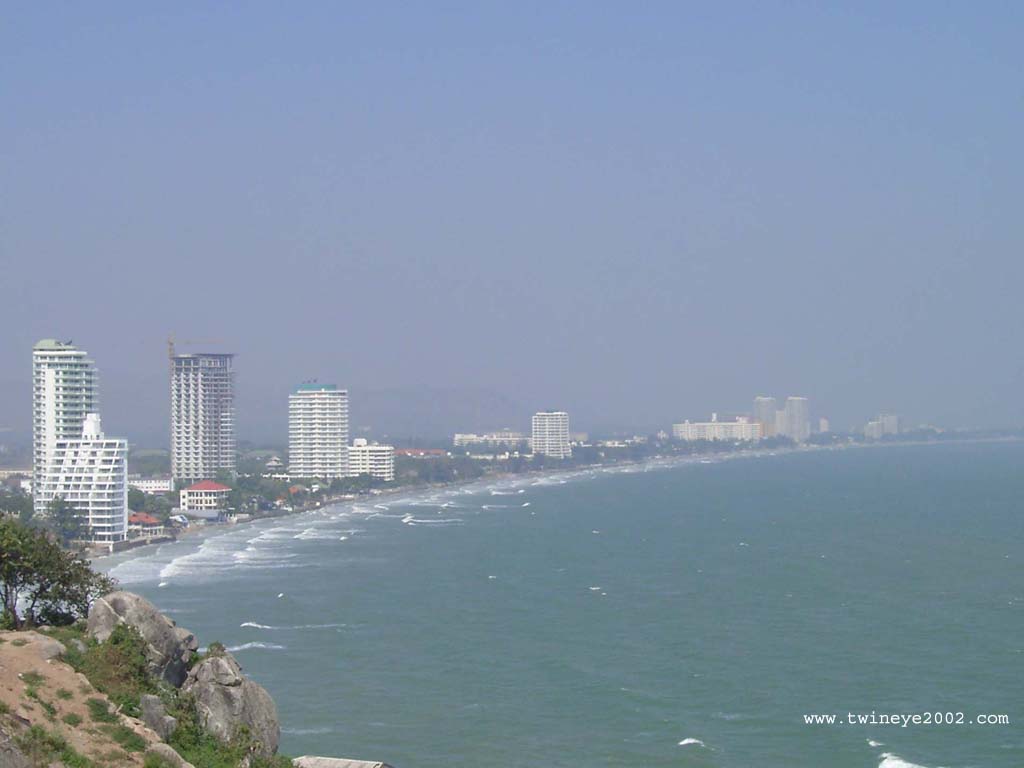
         Hua Hin is unlike any other beach resort in Thailand. If you're looking for bright lights and the frantic all-night action of cabarets and discos, you may be disappointed here.


       However, if you enjoy walks through the quiet winding streets of a friendly coastal village, sampling delicious seafood in restaurants overlooking the brightly lit fishing boats on the Gulf of Thailand or a round of golf on one of the several international standard links, Hua Hin could very well be what you're looking for; Hua Hin has a special character all its own.

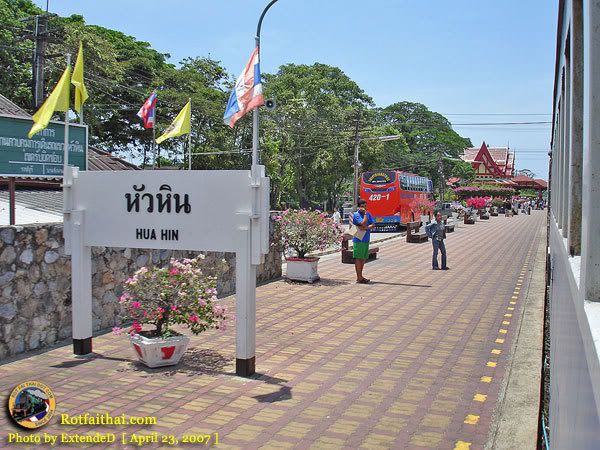
      Hua Hin became popular as a rainy season retreat in the 1920's with the construction of the railway line from Bangkok. The beautiful, colonial style Railway Hotel was built near Hua Hin's famous rocks in 1923 by the State Railway Authority, which also built Thailand's first public golf course in Hua Hin in 1924.


      In 1926, King Rama VII built the Klai Kangwon (Far From Worries) Palace on the beach a few km north of the Railway Hotel and this palace is still frequently used by the Royal Family. This set the stage for Hua Hin's popularity and unique ambiance which remains to this day.


WAT RONGKHUN TEMPLE [ CHIANGRAI in THAILAND]


        The city of Chiang Rai in northernmost Thailand is one of the remaining areas where traditional Thai art and culture flourish. Located near the city of Chiang Rai, about 5 kilometers to the south, is the beautiful Wat Rong Khun or White Temple.

        The White Temple of Northern Thailand has become a national landmark and, as one of the most recognizable temples in the country, attracts an increasingly large number of visitors every year.


       This trip is not my first time visiting the White Temple but its striking white radiance always brings an overwhelming feeling to me once I arrive and step out of the vehicle.


        Wat Rong Khun is unique from other temples in that it has been constructed entirely in a radiant white color with sparking reflections from mirrored glass mosaics embedded in the white plaster. The temple is the idea of Mr. Chalermchai Kositpipat, one of Thailand’s most renowned artists, who wanted to build a temple all in white to signify the purity of Lord Buddha.


       The artist continues to puts his religious belief and desire to enrich Buddhism in Thailand into his contemporary art design. The construction of the White Temple is Khun Chalemchai’s master work, which he refers to as an offering to Lord Buddha and his beloved country.


         To approach the main entrance to the main chapel, I assume must signify a kind of passage to enlightenment because this is how I feel approaching the temple. The passage is flanked by two tremendous man-like giants who somehow frighten me until I have to lower my eyes.


         But this doesn’t help me at all, as those grasping hands near the floor shake my nerves again. The hands are in assorted array, outstretched and seem to be pleading. I realize that this piece of art must symbolize hell and how people in hell will suffer from their bad karma.


         While climbing the bridge to the main hall, I notice that I am surrounded by a huge pond containing white fishes and fountains that spout up every now and then. The pond, to me, perhaps signifies the river – Si Tarndon – that divides the mundane world from heaven. As I get closer to the main building I think that this must be a representation of heaven.


         Before the main chapel and at the end of the bridge there are several sculptures of meditating Buddha sitting in a lotus circled by spirits of the world. The outer-decoration of the temple hall is all white color representing purity and wisdom of Lord Buddha, however, a dramatic contrast of color is found when arriving inside the main hall. I feel a sense of serenity when looking at a several Buddha altars set inside golden flame.


         What surprises me the most is how the walls are painted with a colorful larger than life story related to Buddhist and teaching in a very modern and contemporary style. The artist uses icons from modern culture and through space ships, super man, and even Neo from the Matrix movie he tells of the story of Buddha in this very unique display.


         On the left of the temple’s compound is a golden toilet which Chalermchai seems to also use to transfer some hidden message to visitors. It is as though he is saying, “I want this golden toilet to be a symbol of the human response to imagery.” I am one of the many who paused to consider what may be the artist’s message. Perhaps the message is also that there is beauty in all things, just like this golden toilet which impresses people by its beauty rather than the fact that it is just a toilet.


       Chalermchai wishes Wat Rong Khun to become a learning and meditation centre for people to practice dharma and gain benefit from the teachings of Lord Buddha.



Wednesday, March 3, 2010

'Koh Phi Phi '


     ‘Ko Phi Phi is changing, there has been a drop in the backpacker population and an increase in the suitcase brigade, ’ Hood said. ‘Backpackers can’t afford to stay here anymore.’


     It’s true. Although Ko Phi Phi retains a mellow backpacker vibe, cheap bungalows are few and far between, and those that exist seem overpriced for the cramped, dark and dank environs you get. The outlook is only slightly less dismal in the midrange and top-end bracket – expect to pay nearly double what you would on the mainland, for half the amenities and swankness. Why is Phi Phi so expensive these days?


        For two reasons, Hood says. First, electricity is hugely expensive on Phi Phi because the island is not supplied with electricity from the mainland and has to rely on generators. Ferry and long-tail boat prices are also increasing – rates are tied to the price of petrol, so if petrol prices drop drastically in the next two years, expect prices to go down (we wish!).


     On the plus side, Phi Phi is building sounder structures these days (probably another reason prices are going up). Instead of fly-by-night bungalows, Western style buildings, constructed to withstand a tsunami, are going up. Designs include open-air staircases people can use to climb onto the roof in a hurry.


     And even though Ko Phi Phi will seem expensive compared to the rest of Thailand, if you compare it to other gorgeous islands around the planet, we think you’ll discover this paradise actually comes pretty damn cheap.


Koh Lan [[Pattaya]]


       Pattaya has a number of islands in its vicinity of which Koh Lan is the largest. The island is somewhat an extension of the mainland activities, featuring water sports such as diving snorkeling, windsurfing, waterskiing and para-sending. A key attraction is boats sailing around the island for sightseeing purposes.


       Some of the boats have glass bottoms enabling passengers to see coral and marine life at the bottom of the sea. The island has a number of beaches, the main beach hosting a number of excellent seafood restaurants selling dishes made from freshly caught seafood. The area also features deep sea fishing boats around Koh Lan’s neighbours, Koh Krok and Koh Sak.


       Details: Koh Lan is 45 minutes from Pattaya beach by boat or 20 minutes by long-tail boat. Most of the tour boats make anchor to take advantage of the foodshops and stalls along these beaches. Facing Hat Thong Lang are coral ranges. Visitors can choose glass-bottom boats and surface-diving. Hat Samae is located to the southwest while Hat Ta Phan is to the west of the island.


          How to get there: Ferries leave South Pattaya Pier daily from 10:00 to 18.30, the one-way fare being 20 Baht. The return ferry leaves Koh Lan’s Na Ban Beach at 12:00 and 14:00.


        Koh Larn Island Tour

        Trip Description : Just off the coast of Pattaya lies the Koh Lan (Coral Island) with clear water and good for snorkelling and diving opportunity.


        Island of Tranquility

        Koh Lann offers a change of pace from the busy beaches of Pattaya - an island well known to Thai and foreign visitors for its tranquil surroundings, beautiful beaches, glass-clear waters and extensive coral. This landmass of four square kilometers, just seven kilometers from Pattaya Bay, sports three beaches and is Pattaya??s closest island just a 45-minute boat ride from shore.


         Watery Pursuits

        Koh Lann is a lovely spot catering to all kinds of tourists. Whether you want to laze around on the island??s soft, white sand, or get more lively and play a few water sports is up to you. The island offers parasailing, water-skiing and jetskis.


        Snorkeling and deep-sea diving are recommended off the nearby islands of Koh Krok and Koh Sak, where there is an abundance of coral and undersea life waiting to be discovered. However, tourists should bring their own diving equipment since there are no dive shops in this area.

Tuesday, March 2, 2010

Wat Yai Chaimongkol At Thailand


       Wat Yai Chaimongkol, an ancient school of meditation in Thailand[1] , is rich in its tradition of meditation teachings. It is situated 70 kms north of Bangkok, has a retreat environment and far from the stresses of modern city life. Wat Yai Chaimongkok offers not only a quiet world of meditation to discover the nature of mind but also methods to purify it.


        It is the meditation that slowly frees us from all pains, fears and immeasurable sorrows. All the spiritual learning (Pariyat Sattadham) and practicing (Patibhat Sattadham) in meditation are aimed at that one single point: to putting an end to suffering (Pattiwet Sattadham).


       With the right teaching and training, Wat Yai Chaimongkol presents simple but powerful meditation practices from the heart of the Ayutthaya tradition. Since the meditation is universal and cuts through political and religious barriers, therefore, anyone, whatever their religion or background, can practice.


There are two approaches to be followed:

         1) The practice of Concentration Meditation (Samatha Khammathan) to defuse turbulent emotions and find spacious clam and

        2) The practice of Insight (Vipassana Khammathan) to arise with wise wisdom in reaching the goal of human existence, enlightenment.


          For the beginners, the method is very simple, just to rest your attention on the breath by breathing in and out and uttering “Bhuddho” from moment to moment. A beginner should practice in short sessions to follow thoughts that arise in their heart of hearts.


       As the practice of meditation continues, one may experience stress relief and further spiritual development such as states of bliss, clarity, the absence of thought, and eventually the lasting happiness. During the spiritual practice, the spiritual practitioners must be mindful of whatever they do, and must not lose their presence. Be at ease, be as natural and open minded as possible.


         We warmly welcome and invite all to attend the meditation sessions of Wat Yai Chaimongkol including recitations, Dharma teaching and talks, etc as presented in the tables on the right. Please note that the schedule of activities is intended as a general guide only. For up-to-date information, please visit our contact page.


http://fwmail.teenee.com/strange/14346.html
http://www.watyaichaimongkol.net/index.php?mo=3&art=199079


-