Monday, February 22, 2010

Taley Bangkok Pub and restaurant.


Taley Bangkok Pub and restaurant.


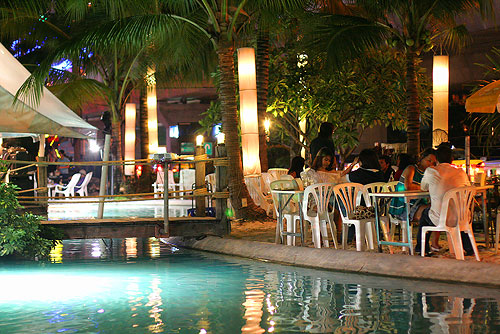
        I spent two night in Bangkok last sept and both nights I ate at the Bangkok Talay which was recomended to me by a Thai friend of mine. The food is delicious and the restaurant itself is pretty cool with having a beach theme. The staff are sound and you can also get Singha on Draft. The restaurant is 5 minutes on foot away from the famous RCA Night club which is very handy too. Try the fish cakes and snapper fish. Delicious


      Decorated store outside and around the model described the sea as a pot era concept in decorating stores. Highlights of the store is decorated to a clean white beach with soft white hair from detailed Rayong. Cut to simulate the blue blue sea. Adorned with decorated with tropical palms to clean the shell and coral white chairs lined canvas chairs surrounded. Beach area that has children living sand. Suitable for both leisure cluttered weekdays after work. And holiday. Without a journey to the provinces.


       Bangkok Restaurant Pub & Co. Red Sea State the vice list. Located near Rama 9 Road Soi 6 Rama highway adjacent to the hotel nine walk RCA Radio Johnson. Open from 17:00 to 24:00 hours


Buddha.City Pillar Shrine


        According to an old Thai tradition, a city pillar had to be built upon the establishment of a new city. King Rama I had the Bangkok city pillar erected near the Temple of the Emerald Buddha on Sunday, 21 April, 1782, with the citys horoscope inside. The original pillar was made of cassia wood known as Chaiyaphruek, measuring 75 cm. in diameter and 27 cm. high. In the reign of King Rama IV, the old dilapidated pillar was replaced by a new one made of the same kind of wood, measuring 270 cm. high and standing on a base of 175 cm. wide, sheltered by a Prang-shaped shrine as it appears today.

        The shrine also houses images of protective deities including Thepharak, Chaopho Ho Klong, Phra Suea Mueang, Phra Song Mueang, Chaopho Chetakhup and Phra Kan Chai Si.


Knowledge : http://thailandtravelhit.blogspot.com/2008/10/city-pillar-shrine-bangkok-thailand.html


'Huaymaekamin' Waterfall Floor 7.


       Waterfall Huay Mae turmeric. Conditions are very beautiful. Around a tropical forest with various species of wood. Waterfall flowing from the mountains upstream, the rainforest one's drought east of the park. And flow into the Srinakarin Dam Reservoir. It is one of the most beautiful waterfalls, sheer.


         Waterfall Huaymaekamin floor is divided into 7 different name to each class for each high and beautiful difference. National Park are major tourist routes in each level are also walking trails, waterfalls and nature study. Opportune time to travel is during the month of October -. April.


       Now the rainy season arrived early rain shower began. Forest green. Long waiting time of the year is arrived at another beautiful waterfall waterfall brook even the turmeric in check j holds. Waterfall in a dream that will need to keep a picture of one of my life. When it comes to beauty than to think it.

      Although not much smooth player. But many people come together, then enjoy.The beauty of this move make sure that far. You do not forget to visit here together.


ที่มาความรู้ http://www.paiduaykan.com/


Beauty under water with 'Tarutao'


      The history of Tarutao is tied to the history of democracy in Thailand. The need for an isolated and forbidding environment to lock away enemies of the state caused the Corrections Department to build a penal colony there in 1939.


     Two important revolutionary groups were imprisoned here: the Bowondet coup group and the Petty Officers' coup group. Their coup attempts were unsuccessful, but ushered in change nonetheless, and soon a democratic constitution was drafted.


      The first prison was located at Talo Udang Bay, but hundreds of new prisoners came every month, so Talo Wao Bay became the second site. Prisoners were forced to build a road 12 km. long and 6 m. wide between the two bays.


       From interviews of old guards and prisoners, it was learned that almost 1/3 of the convicts died on the island. Malaria was the main cause of death; but cruelty from guards and starvation were also other major factors.

        Escape was a disheartening prospect, due to crocodiles, sharks and fierce guards. But not all prisoners were miserable. The political prisoners were naturally respected due to their social status, rank and education; and enjoyed an "open prison" atmosphere away from the common prisoners. They whiled away their time in useful projects, including agriculture, plant propagation and translation and dictionary-writing. After their return to the real world, many returned to high government posts.


       Order eroded in the camps during WW II. Supplies no longer came from the mainland, and starvation ensued. Both guards and prisoners soon became the most feared pirates in the area, preying on merchant ships in the Strait of Malacca. This quote describing earlier piracy sums up the boat owners' terror:


        "Not only on land, but perhaps more so at sea, the Western traveler feared for his safety ..... countless white travelers recorded their fears of, and warnings about the savage marauders of the archipelago who thrived on massacre, violation and rapine. In many eyes, the rich and beautiful islands seemed to have become mutated into some nightmarish landscape -- the indented coasts, estuaries, creeks, rivers and narrow channels affording concealment for the pirates' murderous pillage, with 'no vessel ..... safe, no flag ..... respected.' (Raffle)"


Knowledge : http://www.dnp.go.th/parkreserve/asp/style2/default.asp?npid=7&lg=2


Phra That Doi Tung. The beauty of religion.


       Wat Phra That Doi Tung Wat Phra That Doi Tung is situated on top of Doi Tung Mountain, the highest mountain in Chiang Rai Province with an elevation of approximately 2,000 meters, about 50 kilometers south of Mae Sai town which is near the Myanmar border.

       The temple can be reached via a 40-kilometer mountain road which meanders along the mountainside. The journey is worthwhile as the panoramic views into Laos and Myanmar at the peak are spectacular.


        Wat Phra That Doi Tung was constructed in the 10th century and was renovated by Chiang Rai's most famous ruler King Mengrai during the 13th century and by the famous Chiang Mai monk, Khru Ba Siwichai, at the turn of the 20th century.


     The temple complex is comprised of twin Lanna style chedis, one of which is said to contain the left collarbone of the Lord Buddha. Throughout the year, the holy relic draws devout Buddhists from all over Thailand, Laos and Myanmar.


Knowledge http://www.tourismthailand.org/attraction/chiangrai-57-3802-1.html

Beauty amidst mountains ... Phurua new year (even long passed).


       Featuring an odd, boat-shaped rock cliff, this national park (Boat Mountain) consists of several sandstone peaks and a vast pine-covered mountain plateau. Elevated at a level of 1,375 m, and covering an area of 121 sq km, Phu Rua offers some breathtaking views, and a broad spectrum of natural flora and fauna. The top of Phu Rua also offers some truly spectacular views into the Lao countryside, as well as of the Heang and Khong Rivers.

        Popular natural attractions include Pha Lon Nai - a cliff offering a wonderful panoramic view of the sunrise, Pha Sup Thong or Pha Ku Lap Khaw (White Rose Cliff) - a very steep cliff teeming with white roses --and Huai Phai Waterfall - an eye-catching 30 meter-high waterfall. Tents and bungalows are available at the park and reservations can be made with the National Parks Department.


       Phu Rua National Park can be reached by bus from Loei, and from the Lom Sak District of the Petchabun Province. Cars can also be hired, and is typically a much more convenient method of travel, as public transportation is difficult to find all the way from Loei to the park, especially on weekdays.


knowledge : http://www.thailand.com/travel/eco/eco_loei_phu%20rua.htm


'Pai' town.


         Once a gorgeous sleepy town, Pai, while still rather gorgeous, is well and truly on the traveller map through northern Thailand. Old timers and more experienced travellers may sneer at it, as it's certainly not the "real Thailand" any more but if you're a young backpacker on a first trip to Thailand it can seem like a great scene and it is easily accessible in every sense.


       Pai old city, situated on the left bank of Pai river by Wiang Nur village, dates back to the Lanna period when it was an important regional centre, though there's nothing much left of it to see these days. During the 1970s it was probably a fairly dangerous spot, being a Kuomintang-controlled area and an important opium transit centre. In the 1980s the area was cleaned up and a sealed road to Pai was built.


        The pesky KMT were offered decent farmland and Khun Sa and his Shan State Army were far enough away to not pose a threat, while the lingering KMT insurgency was restricted to remoter northern areas such as Nan, effectively making the area attractive to tourists at last.


         Pai was relatively easily accessed from the existing tourism centre of Chiang Mai and soon became de rigueur on any northern Thailand trip. It was originally popularised as a rest-stop on what was once a far more gruelling bus trip from Chiang Mai to Mae Hong Son, but adventurous trekkers soon started to flood in along with a wave of backpackers looking for cheap grass, easily available opium and something to do while waiting for the next Ko Pha Ngan full moon party.


         The drugs scene has now been seriously clamped down upon and Pai has had a bit of a rebranding as a rural Chiang Mai with wholesome activities, picturesque scenery and a chilled out scene.


         The influx of farang with northern Thai wives setting up cafes or guesthouses in Pai has been followed by a second influx of pseudo-hippy types from the further reaches of Chattuchak market and Ko Pha Ngan, who have set up resorts for weekender Thai yuppies from the big cities. Shops selling handicrafts, jewellery, tattoos, mojitos and traditional Lisu cheesecake and cappuccinos now abound.
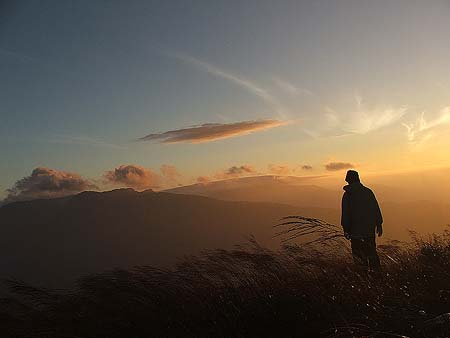


         Bangkokians looking for a sea change too have bought up land and built either resorts or personal homes in an attempt to recreate what they feel has been lost in Thailand's urban centres. A strong new age scene translates into an organic food industry and all manner of holistic courses being offered. Yoga courses and classes, Thai cooking schools and a near endless range of massage and spa treatments all vie for attention.

      Unlike Chiang Mai and to a lesser extent Mae Hong Son, Pai doesn't have much to see in the traditional sense of sightseeing. Rather people come to either just hang out and bide their time, or to explore the hinterland. A plethora of activities are available, including exploring the countryside by foot, motorbike, elephant or bamboo raft.


      The mountainous scenery and proximity to the Burmese border has seen several ethnic minority groups settle in the area and these villages are often visited by the treks striking out from Pai -- as are some of the surrounding waterfalls. In more recent years white-water rafting has become popular and it's possible to raft almost all of the way to Mae Hong Son.