Thursday, February 25, 2010

Prasat Khao Phanom Rung.


         Prasat Phanom Rung

        The inscriptions of Prasat Phanom Rung offer a unique insight into the nature of Khmer rule in Northeast Thai-land between the 10th and 13th centuries AD. They record the family history of Narendraditya and his son ,Hiranya, making it clear that they ruled autonomously, not as vassals to the king at Angkor. Some of this history is depicted on the narrative reliefs adorning the main sanctuary. If, as they appear to, these reliefs do relate to Narendraditya ‘s life, they represent the earliest portraiture and carving of historical scenes in Khmer art.


        Let us begin with the setting, for the name ‘Phanom Rung ‘ refers to the ancient volcano upon which

       The temple sits. Phanom Rung hill rises over 350 metres


      above the surrounding plain. On a find day, one can gaze across the floodplain below. The eye is first caught by the sparkle of water in the baray or reservoir of the neighbouring temple of Muang Tam, and then by the dark grey foothills of the Dangrek Mountains, the border of Cambodia. The strategic value of the gill – top location of Phnom Rung continues to be appreciated today by the Thai Royal Air Force, who share the crest of the mountain with the ancient temple.

       In former times, Phnom Rung was midway between the great city of Angkor to the south and Phimai too the northwest. The ruler who controlled the Phnom Rung area most probably also had suzerainity over the fertile floodplain stretching south to Prasat Muang Tam. This powerful fiefdom appears to have been held during one of the most prosperous periods of the region ‘s history, by the family of Narendraditya.


         Hiranya has also set out his own biography, noting that at the age of 15 he completed a grammar course and graduated at 16. By the age of 18, he had proven his prowess as hunter of elephants, and at 20 had the golden image lf his father made. Presumably, these dedications by Hiranya were male to celebrate an addition to the monactery and a bid for control based on deification of his father, and idertification of himself with this power.

        Unfortunately we know nothing more of the family’s history, for the K.384 inscription is the last to be erected at Phnom Rung.


       Among the other inscriptions , however , are fascinating details of the religious practices of the monastery on Phnom Rung hill. One, with an inventory number of BR.14, is carved on a rounded stone slab almost, a metre high, a shape associated with sema stones or bounday markers. The inscription on the stone dates to the 12th century,


Sunflower field.


        The Sunflower Festival in Thailand starts around November and goes on until about February. The best places to see sunflower fields are in Lopburi Province and Saraburi Province. It was Lopburi where we went last weekend to see the sunflowers.
 
        Thousands of people from Bangkok head this way at the weekends for a day trip to take pictures in the sunflower fields. For people in Lopburi it has started to become a major tourist attraction. Each farm takes turns in planting the sunflowers so that there is at least one area of blooming flowers during this period. According to latest statistics, there is now 12,000 acres of sunflower fields in Lopburi alone. As well as being a tourist attraction, they also extract oil from the sunflower seeds and of course make tasty snacks.


         The best places to see sunflowers in Lopburi are in the districts of Phatthana Nikhom, Chai Badan, and Khok Samrong. From Bangkok, we took Highway 1 north through Saraburi and then turned off onto Road 21 a little while later. A short distance along this road we came across two major sunflower fields with beautiful mountain backdrops.

         We then later turned right onto Road 3017 towards Pasak Jolasid Dam. We had an enjoyable picnic at the dam and then drove back along Road 3017 towards Lopburi. Again we saw plenty of sunflower fields. Some were on the main roads. Others had signs telling us where to turn off. If you have a car and drive around this area then you will surely have no problem.


        Most farmers will charge you about 5 or 10 baht to enter their fields to take pictures. We found others along side roads which were free. The places that charge admission usually also have stalls selling souvenirs and snacks relating to sunflowers. They also offered tractor and cart rides throught the fields and also a few places had elephant rides. Most Thai people just went to the sunflower fields to take pictures.

        Usually of each other. If you don't have your own transport, then you could join the special train trip that goes from Hua Lamphong Station in Bangkok to the sunflower fields around Pasak Jolasid Dam. The train goes only at the weekend and on public holidays. It leaves Bangkok at 6.40 a.m. and returns eleven hours later. Prices start from 255 baht and go up to 675 baht for first class.


Moohin.com


Wednesday, February 24, 2010

Phetchaburi 'Kaeng Krachan National Park'


              Kaeng Krachan National Park, Thailand

         Thailand has many green oases, but the 2,915 sq.km. Kaeng Krachan National Park in Petchaburi Province spanning the border with Burma/Myanmar, .is the largest. A three hour drive from Bangkok on the way South towards Cha’am, Hua Hin and Phuket, this wilderness is unparalleled for its rich diversity.


        Flora, Fauna and Accommodation in Kaeng Krachan National Park.There are over 250 species of insects and moths, over 450 species of birds including hornbills and the black drongo, plus spectacled langurs, Fea’s barking deer, tapir, elephant, wild dog, monkeys and gibbons. Rumours surface periodically of other wildlife including tigers and the Asiatic leopard. The rumours usually start after someone has gone into the park, disregarded the rules, and got lost. In recent years, two campers disappeared completely, never to be found.


        There are no luxurious hotels anywhere near the park, but the park provides 18 guesthouses and a camping facility around its headquarters, Ban Krang Camp, for 100 tents and Phanern Thung Camp with 60 tents. To reach the latter, a 4WD and experienced driver is required. During the cool months of December-March a dense fog blankets the deep valleys during the mornings.


       In a mountainous landscape with incredible views of sunrise and sunset and the lower valley at dawn covered in mist, with hills surging upward out of the mist like fingers piercing filmy gauze, the camping site is a tranquil spot in which to spend a week-end.


http://thailand-travel.suite101.com/

Vintage Village - Plearnwan


       Plearnwan is a theme city under a nostalgic concept - Eco Vintage Village located at the opposite side of the royal residence of Klai Klangwan (Royal Palace, Huahin). The place is pack with classic Thai food and snack stalls such as Ga-Lor-Jee which taste like Japanese Moji, Kee-noo, Tang-Tem and etc.


        Apart from food and snack, there’s many theme shop in the place from salon, boutique hotel, movie theatre, music shop, fashion, photo shooting studio, toys, and massage.


       Food is delicious sparkling water, but this traditional abdominal pain but also to a strange delicious.Friday through Sunday during the festival will also write a about 17.00 - 22.00.


Ancient city of Thailand in Samut Prakan.


       Ancient City is a park spreading over 200 acres in the elephant-head shape of Thailand. In their correct geographic position, replicas of all the country's most historically significant structures have been erected, some full-size but most scaled down. All have been accurately and meticulously recreated. Some buildings are even genuine, moved here for preservation.


      Other genuine buildings have been transported to recreate traditional scenes of Thai life, such as The market of Yesteryear, the Floating Market and the Northern Thai Hamlet.


       Another facet of Ancient City is the beautiful gardens, some of them portraying Thai legends with bronze horses flying over waterfalls and suchlike.


Maeil www.sriwittayapaknam.ac.th/


Tuesday, February 23, 2010

'PHU CHI FA' Chiang Rai


       Phu Chi Fah Forest Park is located in the area of the Pa Mae Ing and Pa Mae Ngao National Forest Reserve, which falls within Baan Rom Fah Thong Moo 9 and Baan Rom Fah Thai Moo 10, Tambon Por, Wiang Kan District, Chiang Rai Province. The area also falls within the Forest Conservation Area (Zone C) with total area of approximately 2,500 rais announced by the Royal Forest Department as a Forest Park on 6th February, 1998.


      TopographyThe area is in the midst of Doi Pa Mohn Mountain range along the Thai-Laos border. The area is 1,200-1,628 meters above average sea level and an average slope all round of approximately 40%. The highest spot is recorded at the observation point.


       ClimateTemperature up on the hills can be quite cool but season wise, it would be more like Tropical Monsoon with influence from South-Westerly wind during rainy seasons and North-Easterly wind during winter. There are 3 seasons altogether in this area – summer from March to May, rainy season from June to September and winter from October to February.

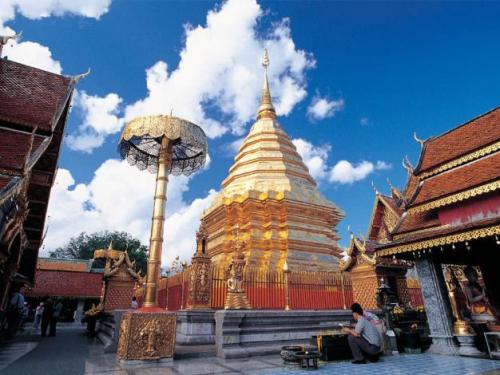
Doi Suthep Temple


       Doi Suthep is a mountain, about 15 kilometers from Chiang Mai, with on it Wat Prathat Doi Suthep, a Holy Buddhist Temple. Every Temple with a name starting with Wat Prathat contains Buddha relics and therefore is Holy to Buddhists.

      The place can easily be reached from Chiang Mai. I would say that it is hard not to find a bus or car that wants to bring you there. As you can see on this page, Doi Suthep certainly is worth a visit.


       When you reach this Holy Buddhist place, the first thing you will notice is business (left hand side picture), as usual everywhere in Thailand. To reach the Temple of Doi Suthep, climb the stairs (see the right hand side picture) for the best experience.

       There has been a kind of rail-elevator, that has been closed down after an accident. It was not in operation in 2004. I do not know if this elevator has been re-opened ever since.


       There are about 300 steps to climb. The reward is more than worth the effort. You will see a beautiful Buddhist Temple and you will experience a beautiful view. While climbing the stairs, you should pay attention to the giant dragons on the sides of the stairs (they appear already downstairs; see the right hand side picture).