Showing posts with label Thailand trip. Show all posts

Friday, February 26, 2010

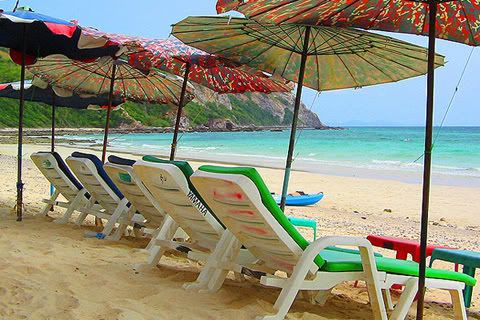
Pattaya beach


        Pattaya is a popular tourist resort on the North Gulf Coast of Eastern Thailand, located 150 km south-east of Bangkok. Pattaya is most famous for its go-go and beer bars, but local authorities has made efforts to provide more family-friendly attractions and activities, and specialist conference and golfing facilities. Although the sex industry is still going strong in Pattaya,

       the resort also attracts local families and holidaymakers from far and wide. Efforts by the local authorities over the past few years have improved the quality of the beaches, but they are still lacklustre by Thailand's high standards, and over-development has long since destroyed some of the natural charms the area once had. However, the plethora of hotels and guest houses, and easy access from the capital and airport, make it a popular weekend getaway.

       Catering for over five million tourists yearly, Pattaya is also able to offer an excellent range of eating choices and a wide variety of things to do and see. Its population is a colorful mix of nationalities and ethnicities from near and far.


        "Greater Pattaya" occupies most of the coastline of Banglamung (one of the eleven districts that comprise Chonburi Province . It is divided into a larger northern section which spans the areas to the east of Naklua Beach (the most northern beach) and Pattaya Beach (the main beach) plus the Buddha Hill headland (immediately south of Pattaya Beach), and a smaller southern section covering the area to the east of Jomtien Beach (which lies directly south of Buddha Hill) including Dongtan Beach. Jomtien's beaches are much broader and generally in better shape, and the atmosphere locally is more sedate and family-oriented, than at Pattaya Beach.


        North Pattaya (Pattaya Nua) - not the northern-most part of Pattaya (as Naklua lies further north), but the section of Pattaya adjacent to the northern end of Pattaya Beach and extending inland to both the north and south of North Pattaya Road. Does not include Naklua.

       South Pattaya (Pattaya Tai) - not the southern-most part of Pattaya (as the Buddha Hill headland, and then Jomtien, lie further south), but the section of Pattaya adjacent to the southern end of Pattaya Beach and extending inland to both the north and south of South Pattaya Road. Includes Pattayaland and Walking Street. Does not include Buddha Hill or Jomtien.

      Central Pattaya (Pattaya Klang) - not the dead center of Pattaya, but the section of Pattaya adjacent to the middle of Pattaya Beach and extending inland to both the north and south of Central Pattaya Road. Some maps/guides disregard the Central Pattaya convention, and instead extend North Pattaya and South Pattaya to meet each other along Central Pattaya Road; sometimes, Beach Road is described with a similar division, and the respective halves given "North Beach Road" and "South Beach Road" monikers.


      From bars and stores and stretches out to the beaches. Jomtien Beach the watersport center South of Pattaya is, a seven-kilometer stretch popular with windsurfers and watersports enthusiasts. Jomtien, in fact, is the windsurfing capital of the country, thanks other things, including massage. Swimming is a popular activity on Jomtien Beach. The water here is a little deeper than that


       Boasts an incredible choice of accommodation to suit every pocket. Facilities range from with private beaches to and inland, and. Pattaya has accommodation to suit all budgets and preferences, and for whatever the duration. There is long-term accommodation in the form of lease or rent, A relatively new concept has reached Pattaya




Tuesday, February 23, 2010

Doi Suthep Temple


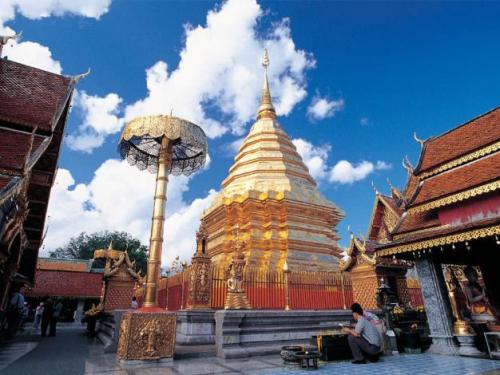
       Doi Suthep is a mountain, about 15 kilometers from Chiang Mai, with on it Wat Prathat Doi Suthep, a Holy Buddhist Temple. Every Temple with a name starting with Wat Prathat contains Buddha relics and therefore is Holy to Buddhists.

      The place can easily be reached from Chiang Mai. I would say that it is hard not to find a bus or car that wants to bring you there. As you can see on this page, Doi Suthep certainly is worth a visit.


       When you reach this Holy Buddhist place, the first thing you will notice is business (left hand side picture), as usual everywhere in Thailand. To reach the Temple of Doi Suthep, climb the stairs (see the right hand side picture) for the best experience.

       There has been a kind of rail-elevator, that has been closed down after an accident. It was not in operation in 2004. I do not know if this elevator has been re-opened ever since.


       There are about 300 steps to climb. The reward is more than worth the effort. You will see a beautiful Buddhist Temple and you will experience a beautiful view. While climbing the stairs, you should pay attention to the giant dragons on the sides of the stairs (they appear already downstairs; see the right hand side picture).


Wat Sothon Wararam Woravihan


        Wat Sothon Wararam Worawihan This temple is situated on the west bank of the Bang Pakong River, 2 Kms. south of the city hall. Enshrined in a new gigantic hall is Phra Phutthasothon, or "Luang Pho Sothon" regarded as one of the most revered Buddha images in Thailand. The image, in the attitude of meditation, measuring 1.65 metres wide at the lap and 1.98 metres high, is always seen entirely pasted with gold leaves by worshipers. Two annual fairs celebrating the image fall in the 5th and the 12th lunar months (around April and November).


        According to legend, Luang Pho Sothon floated down the Bang Pakong River to the site of the temple. Efforts to retrieve it were unsuccessful until a villager had a small shrine erected on the site and performed a ceremony welcoming the image to the community.


      Ancient Fortress This historical site is located on Maruphong Road in the town. This fortress was frequently used during the reigns of King Rama lll and King Rama V. Many old cannons can now be seen along the wall. Nearby, a public park is suitable for viewing the scenery of the Bang Pakong River.


         Bang Pakong River This scenic river originates in the Khorat high plateau and winds through the heart of the town before running into the Gulf of Thailand at Amphoe Bang Pakong. A boat trip along the river can start either from the town market or Wat Sothon, and travellers can go towards Amphoe Bang Khla, a total distance of 25 kms. The trip takes bout 3 hours by long-tail boat.


http://soiban.blogspot.com

Monday, February 22, 2010

Buddha.City Pillar Shrine


        According to an old Thai tradition, a city pillar had to be built upon the establishment of a new city. King Rama I had the Bangkok city pillar erected near the Temple of the Emerald Buddha on Sunday, 21 April, 1782, with the citys horoscope inside. The original pillar was made of cassia wood known as Chaiyaphruek, measuring 75 cm. in diameter and 27 cm. high. In the reign of King Rama IV, the old dilapidated pillar was replaced by a new one made of the same kind of wood, measuring 270 cm. high and standing on a base of 175 cm. wide, sheltered by a Prang-shaped shrine as it appears today.

        The shrine also houses images of protective deities including Thepharak, Chaopho Ho Klong, Phra Suea Mueang, Phra Song Mueang, Chaopho Chetakhup and Phra Kan Chai Si.


Knowledge : http://thailandtravelhit.blogspot.com/2008/10/city-pillar-shrine-bangkok-thailand.html