Tuesday, February 23, 2010

'PHU CHI FA' Chiang Rai


       Phu Chi Fah Forest Park is located in the area of the Pa Mae Ing and Pa Mae Ngao National Forest Reserve, which falls within Baan Rom Fah Thong Moo 9 and Baan Rom Fah Thai Moo 10, Tambon Por, Wiang Kan District, Chiang Rai Province. The area also falls within the Forest Conservation Area (Zone C) with total area of approximately 2,500 rais announced by the Royal Forest Department as a Forest Park on 6th February, 1998.


      TopographyThe area is in the midst of Doi Pa Mohn Mountain range along the Thai-Laos border. The area is 1,200-1,628 meters above average sea level and an average slope all round of approximately 40%. The highest spot is recorded at the observation point.


       ClimateTemperature up on the hills can be quite cool but season wise, it would be more like Tropical Monsoon with influence from South-Westerly wind during rainy seasons and North-Easterly wind during winter. There are 3 seasons altogether in this area – summer from March to May, rainy season from June to September and winter from October to February.

Doi Suthep Temple


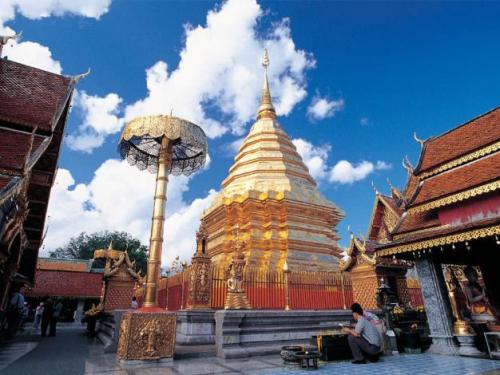
       Doi Suthep is a mountain, about 15 kilometers from Chiang Mai, with on it Wat Prathat Doi Suthep, a Holy Buddhist Temple. Every Temple with a name starting with Wat Prathat contains Buddha relics and therefore is Holy to Buddhists.

      The place can easily be reached from Chiang Mai. I would say that it is hard not to find a bus or car that wants to bring you there. As you can see on this page, Doi Suthep certainly is worth a visit.


       When you reach this Holy Buddhist place, the first thing you will notice is business (left hand side picture), as usual everywhere in Thailand. To reach the Temple of Doi Suthep, climb the stairs (see the right hand side picture) for the best experience.

       There has been a kind of rail-elevator, that has been closed down after an accident. It was not in operation in 2004. I do not know if this elevator has been re-opened ever since.


       There are about 300 steps to climb. The reward is more than worth the effort. You will see a beautiful Buddhist Temple and you will experience a beautiful view. While climbing the stairs, you should pay attention to the giant dragons on the sides of the stairs (they appear already downstairs; see the right hand side picture).


Wat Sothon Wararam Woravihan


        Wat Sothon Wararam Worawihan This temple is situated on the west bank of the Bang Pakong River, 2 Kms. south of the city hall. Enshrined in a new gigantic hall is Phra Phutthasothon, or "Luang Pho Sothon" regarded as one of the most revered Buddha images in Thailand. The image, in the attitude of meditation, measuring 1.65 metres wide at the lap and 1.98 metres high, is always seen entirely pasted with gold leaves by worshipers. Two annual fairs celebrating the image fall in the 5th and the 12th lunar months (around April and November).


        According to legend, Luang Pho Sothon floated down the Bang Pakong River to the site of the temple. Efforts to retrieve it were unsuccessful until a villager had a small shrine erected on the site and performed a ceremony welcoming the image to the community.


      Ancient Fortress This historical site is located on Maruphong Road in the town. This fortress was frequently used during the reigns of King Rama lll and King Rama V. Many old cannons can now be seen along the wall. Nearby, a public park is suitable for viewing the scenery of the Bang Pakong River.


         Bang Pakong River This scenic river originates in the Khorat high plateau and winds through the heart of the town before running into the Gulf of Thailand at Amphoe Bang Pakong. A boat trip along the river can start either from the town market or Wat Sothon, and travellers can go towards Amphoe Bang Khla, a total distance of 25 kms. The trip takes bout 3 hours by long-tail boat.


http://soiban.blogspot.com

Monday, February 22, 2010

Taley Bangkok Pub and restaurant.


Taley Bangkok Pub and restaurant.


        I spent two night in Bangkok last sept and both nights I ate at the Bangkok Talay which was recomended to me by a Thai friend of mine. The food is delicious and the restaurant itself is pretty cool with having a beach theme. The staff are sound and you can also get Singha on Draft. The restaurant is 5 minutes on foot away from the famous RCA Night club which is very handy too. Try the fish cakes and snapper fish. Delicious


      Decorated store outside and around the model described the sea as a pot era concept in decorating stores. Highlights of the store is decorated to a clean white beach with soft white hair from detailed Rayong. Cut to simulate the blue blue sea. Adorned with decorated with tropical palms to clean the shell and coral white chairs lined canvas chairs surrounded. Beach area that has children living sand. Suitable for both leisure cluttered weekdays after work. And holiday. Without a journey to the provinces.


       Bangkok Restaurant Pub & Co. Red Sea State the vice list. Located near Rama 9 Road Soi 6 Rama highway adjacent to the hotel nine walk RCA Radio Johnson. Open from 17:00 to 24:00 hours


Buddha.City Pillar Shrine


        According to an old Thai tradition, a city pillar had to be built upon the establishment of a new city. King Rama I had the Bangkok city pillar erected near the Temple of the Emerald Buddha on Sunday, 21 April, 1782, with the citys horoscope inside. The original pillar was made of cassia wood known as Chaiyaphruek, measuring 75 cm. in diameter and 27 cm. high. In the reign of King Rama IV, the old dilapidated pillar was replaced by a new one made of the same kind of wood, measuring 270 cm. high and standing on a base of 175 cm. wide, sheltered by a Prang-shaped shrine as it appears today.

        The shrine also houses images of protective deities including Thepharak, Chaopho Ho Klong, Phra Suea Mueang, Phra Song Mueang, Chaopho Chetakhup and Phra Kan Chai Si.


Knowledge : http://thailandtravelhit.blogspot.com/2008/10/city-pillar-shrine-bangkok-thailand.html


'Huaymaekamin' Waterfall Floor 7.


       Waterfall Huay Mae turmeric. Conditions are very beautiful. Around a tropical forest with various species of wood. Waterfall flowing from the mountains upstream, the rainforest one's drought east of the park. And flow into the Srinakarin Dam Reservoir. It is one of the most beautiful waterfalls, sheer.


         Waterfall Huaymaekamin floor is divided into 7 different name to each class for each high and beautiful difference. National Park are major tourist routes in each level are also walking trails, waterfalls and nature study. Opportune time to travel is during the month of October -. April.


       Now the rainy season arrived early rain shower began. Forest green. Long waiting time of the year is arrived at another beautiful waterfall waterfall brook even the turmeric in check j holds. Waterfall in a dream that will need to keep a picture of one of my life. When it comes to beauty than to think it.

      Although not much smooth player. But many people come together, then enjoy.The beauty of this move make sure that far. You do not forget to visit here together.


ที่มาความรู้ http://www.paiduaykan.com/


Beauty under water with 'Tarutao'


      The history of Tarutao is tied to the history of democracy in Thailand. The need for an isolated and forbidding environment to lock away enemies of the state caused the Corrections Department to build a penal colony there in 1939.


     Two important revolutionary groups were imprisoned here: the Bowondet coup group and the Petty Officers' coup group. Their coup attempts were unsuccessful, but ushered in change nonetheless, and soon a democratic constitution was drafted.


      The first prison was located at Talo Udang Bay, but hundreds of new prisoners came every month, so Talo Wao Bay became the second site. Prisoners were forced to build a road 12 km. long and 6 m. wide between the two bays.


       From interviews of old guards and prisoners, it was learned that almost 1/3 of the convicts died on the island. Malaria was the main cause of death; but cruelty from guards and starvation were also other major factors.

        Escape was a disheartening prospect, due to crocodiles, sharks and fierce guards. But not all prisoners were miserable. The political prisoners were naturally respected due to their social status, rank and education; and enjoyed an "open prison" atmosphere away from the common prisoners. They whiled away their time in useful projects, including agriculture, plant propagation and translation and dictionary-writing. After their return to the real world, many returned to high government posts.


       Order eroded in the camps during WW II. Supplies no longer came from the mainland, and starvation ensued. Both guards and prisoners soon became the most feared pirates in the area, preying on merchant ships in the Strait of Malacca. This quote describing earlier piracy sums up the boat owners' terror:


        "Not only on land, but perhaps more so at sea, the Western traveler feared for his safety ..... countless white travelers recorded their fears of, and warnings about the savage marauders of the archipelago who thrived on massacre, violation and rapine. In many eyes, the rich and beautiful islands seemed to have become mutated into some nightmarish landscape -- the indented coasts, estuaries, creeks, rivers and narrow channels affording concealment for the pirates' murderous pillage, with 'no vessel ..... safe, no flag ..... respected.' (Raffle)"


Knowledge : http://www.dnp.go.th/parkreserve/asp/style2/default.asp?npid=7&lg=2