Tuesday, March 2, 2010

Wat Yai Chaimongkol At Thailand


       Wat Yai Chaimongkol, an ancient school of meditation in Thailand[1] , is rich in its tradition of meditation teachings. It is situated 70 kms north of Bangkok, has a retreat environment and far from the stresses of modern city life. Wat Yai Chaimongkok offers not only a quiet world of meditation to discover the nature of mind but also methods to purify it.


        It is the meditation that slowly frees us from all pains, fears and immeasurable sorrows. All the spiritual learning (Pariyat Sattadham) and practicing (Patibhat Sattadham) in meditation are aimed at that one single point: to putting an end to suffering (Pattiwet Sattadham).


       With the right teaching and training, Wat Yai Chaimongkol presents simple but powerful meditation practices from the heart of the Ayutthaya tradition. Since the meditation is universal and cuts through political and religious barriers, therefore, anyone, whatever their religion or background, can practice.


There are two approaches to be followed:

         1) The practice of Concentration Meditation (Samatha Khammathan) to defuse turbulent emotions and find spacious clam and

        2) The practice of Insight (Vipassana Khammathan) to arise with wise wisdom in reaching the goal of human existence, enlightenment.


          For the beginners, the method is very simple, just to rest your attention on the breath by breathing in and out and uttering “Bhuddho” from moment to moment. A beginner should practice in short sessions to follow thoughts that arise in their heart of hearts.


       As the practice of meditation continues, one may experience stress relief and further spiritual development such as states of bliss, clarity, the absence of thought, and eventually the lasting happiness. During the spiritual practice, the spiritual practitioners must be mindful of whatever they do, and must not lose their presence. Be at ease, be as natural and open minded as possible.


         We warmly welcome and invite all to attend the meditation sessions of Wat Yai Chaimongkol including recitations, Dharma teaching and talks, etc as presented in the tables on the right. Please note that the schedule of activities is intended as a general guide only. For up-to-date information, please visit our contact page.


http://fwmail.teenee.com/strange/14346.html
http://www.watyaichaimongkol.net/index.php?mo=3&art=199079


-

Wat Ratchaburana in Ayutthaya Thailand


        Wat Ratchaburana was built by King Borom Ratchathirat II at the place where both his brothers died (they killed each other) during a fight for the vacant throne of Ayutthaya. After both his brother had died, King Borom Ratchathirat II became the King. As such, Wat Ratchaburana was built during the early Ayutthaya period. The prang was the centerpiece at the temple compound.


         The vault of Wat Ratchaburana became known to the public some decades ago, and looters broke into the vault in 1957. The looters were apprehended, but a lot of the stolen goods were never recovered. Later on more than 100,000 votive Buddhist tablets were found, as well as gold jewelry with a combined weight of more than 100 kilograms.
 

        The vaults inside the main prang also displayed mural paintings, depicting the previous lives of the Buddha. Unfortunately, over the last few years these images have deteriorated a lot. Only very few visible images are left.


        A large amount of the golden artefacts and treasures found at Wat Ratchaburana are displayed in the Chao Sam Phraya National Museum. This museum also houses a nice collection of Buddha images in different styles, and wooden door panels from different temples in Ayutthaya.


Knowledge : http://www.thaiwebsites.com/watratchaburana.asp

Doi Inthanon National Park


        Located in Chiang Mai Province, Doi Inthanon National Park encompasses the highest mountain In Thailand, Doi Inthanon, as well as several lesser summits.


       The doi (mountain) is largely a granite batholith intruding a southerly extension of the Shan Hills range and forming the divide between the Nam Mae Ping river to the east and the Nam Mae Chaem river to the west.
        Lower elevations in the most easterly pant of the park are limestone formations and contain a number of caves.


        Formerly known as Doi Angka, the mountain now bears (since 1899) a shortened version of the name of Chiang Mai's last sovereign, King Inthawichayanon. During his reign, he had, with great foresight, expressed his concern for the forests of the northern hill country as the watershed for all of central Thailand.


        The modern study of rain forest hydrology has borne out his early convictions and given substance to Thai folklore which describes this hill region as the home of the Phiphannam, the 'spirit who shares water'.
       Before the King died near the turn of this century, he commanded that his remains be placed at the top of this mountain: his ashes at the summit stupa are visited by thousands of people each year.


         The park covers an area of 48,240 ha. Its lowlands below 800 meters in elevation are warm and very dry during the rain-free season, but the summit of Doi Inthanon, at 2565 meters, has a climate more like Canada than Thailand.
        The temperature has been known to drop as low as -8 degrees C. and frosts are not unusual during the cool, dry season. January is the coldest month: an average nighttime temperature is 5.5 degrees C. At any season, Doi Inthanon is a comfortable reprieve from the heat of the lowlands.


        At altitudes above 1000 meters, rainfall exceeds 2500 mm, considerably more than at nearby Chiang Mai. Even in the dry season, November to April, there is rare but occasional rain or the summit may be shrouded in cloud for a part of the day; persistent mist is an important factor in the maintenance of moist forest there.


       The various sub montane forest formations at higher elevations are a unique asset of the park. They have dominant species belonging to temperate climate families rather than tropical. The summit area supports the only red rhododendron in Thailand (R. delavayi); it blooms from December through February. There are also two white-blossomed species abundant on Doi Inthanon which are restricted to only a few other sites.


       Where mists are persistent, the slopes carry a moist hill evergreen or 'cloud forest' with many epiphytes, plants which live on tree trunks and branches but do not receive their moisture and nutrients from the host tree as do true parasitic plants.
       Instead, they are nurtured by the accumulation of dust particles and humus around their 'root' area and the moisture retained there, augmented by frequent bathing in cloud and mist. Epiphytic orchids are also abundant, along with lichens, lianas and fern.


       At mid-elevations, 800 - 1500 meters, two species of pine are present, Pinus merkusii mixed with dipterocarp in the lower range, and P. kesiya with oak and laurel on drier slopes in the upper range. The pines are thought to be a relic from a prehistoric cooler climatic period when flora from the Sino-Himalayan region migrated southward.
      At the mid-elevations of the park, much of the forest has been removed by the activities of swidden cultivators and the slopes have converted to fire climax grasslands.


Source :   www.chiangmai-chiangrai.com/doi_inthanon_park   
http://www.dnp.go.th/parkreserve/asp/style1/default.asp?npid=1&lg=1

Monday, March 1, 2010

KOH SAMET of Thailand


        Welcome to one of Thailand's hidden jewels: The island of Koh Samet. This beautiful island has it all: superb beaches, lovely coral reefs, excellent dining and an atmospheric night life.


         Less than seven kms off the coast of Rayong Province in the eastern Gulf of Thailand, it combines the allure of a tropical paradise with reasonable proximity to Bangkok. Koh Samet has been known as a safe anchorage for sailors since at least the 13th century and in the 19th century its sheer beauty was the inspiration for the literary masterpiece of Thailand's most famous romantic poet, Sunthorn Phu.

 
         Koh Samet was once mostly for well to do Thais and local Thai tourists, but as travelers from far and wide started hearing talk of the paradise island with the smooth white beaches - things started changing. Today Koh Samet offers a variety of accommodation starting with the excellent (and expensive) Paradee Resort & Spa over to more modest accommodations.


         Choosing where to stay

         It is often difficult to know just where to stay when visiting an island for the first time. Koh Samet is actually a very small island and regardless of which beach you stay by, you can easily get to the other beaches in less than 15 minutes. Generally speaking, most of the higher end resorts are located by Saikaew Beach, which is also the liveliest beach on the island. Ao Vongduan Beach is also popular, but most of the beaches offer a variety of choice and are good choices to stay at.


-

Welcome to "Songkran Day"


     Welcome to "Songkran Day" This is a Thai traditional New Year which starts on April 13th - 15th every year.


     Songkran is a Thai word which means "move" or "change place" as it is the day when the sun changes its position in the zodiac. It is also known as the "Water Festival" as people believe that water will wash away bad luck. The word Songkran comes from the Pali language of the Therevada Buddhist scriptures (Sankhara) and the Sanskrit word (Sankranti) for movement or change.


     In ancient times, it was celebrated as a moveable feast, and set to occur as the sun moved into the Aries portion of the zodiac. In modern times the date has been fixed as April 13.


     Although the Thai people officially changed the New Year to January 1 in 1940 to coincide with the Western business world, the traditional Songkran Festival is still celebrated as a national holiday in Thailand.


     The festival lasts for 4 days. Maha Songkran Day is the first day of the celebrations which marks the end of the old year. April 14, Wan Nao is the day between the ending of the old year and the beginning of the new year when foods are prepared for the temples. The third day of Songkran, April 15, is Wan Thaloeng Sok - the day on which the New Year begins and on the last day, Wan Parg-bpee, the ancestors and elders are honored.


     - World's Biggest Water Fight -

     Khao San Songkran Festival


     The Songkran Festival shares some similarities with the Holi festival in India celebrated around the same time. One custom that Songkran shares with Holi is the releasing of small fish back into the rivers and steams. In Thailand, small birds may also be released from cages as part of the festivities.


     While in India the throwing of colored water marks Holi, the Thai Songkran Festival involves throwing clear water - and lots of it! - although many add colored powders and scents to the water in Thai New Year celebrations in playful "water wars."

     The tradition traces back to the pre-Buddist rituals of spring festivals where the throwing of water was meant as a symbol of luck to bring good rain for the crops. It was later converted to the religious custom of cleansing the statues of Buddha once a year. In many places there are parades with the statues of Buddha and as the parades pass, crowds shower the Buddha with water.


     Pouring small amounts of scented lustral water on the heads of the elders on Wan Parg-bpee as a sign of respect is also part of this custom. In many temples throughout Thailand people bring sand to symbolically replace the sand that they have carried away on their sandals throughout the year. The sand is formed into pagodas called phra chedis sai and decorated with colorful flags as part of the Songkran New Year festivities. It may be that this tradition began as part of the cleansing rituals where new, clean sand was added to the floor of the temple once a year.


     The foods that are served at traditional Songkran Festivals depend on the part of Thailand you visit. Pad Thai Noodles; Khao Chae, a delicious rice dish; Gaeng Kiew Wahn Gai, chicken with green curry; krayasad, a mixture made from puffed rice, oats, peanuts and Thai noodles that is sweetened with palm sugar and coconut syrup; Kanom Tom, sticky rice and mung bean balls piled high into a pyramid shaped dessert and Kanom Krok, coconut rice pancakes are some of the more universal Thai foods enjoyed during the Songkran festival.


-

Saturday, February 27, 2010

THE SECRET WONDERS OF THE KOH CHANG


      Koh Chang Marine National Park is new and virtually unknown to the outside world. Few people know of its secret wonders. Some even boldly call it “the last paradise islands in South-East Asia”. A paradise it is, Koh Chang Marine National Park has been a heaven to the locals who need to replenish their mind and energy, to recharge.

    Koh Chang is the largest of the 52-island Marine National Park, all of which are untouched by modernization with their natural resources kept intact. Thus, qualifying the park as a dream escape, a true hideaway, far from the bustling city-life. But in fact, Koh Chang is only 330 kilometers east of Bangkok or approximately 4 hours by road plus another 30 to 45 minutes by boat or ferry.


      It is surprising even to the Thais that Koh Chang is actually the second largest island in the whole of Thailand, behind Phuket. Despite its size and close proximity to the capital, Koh Chang is least known, undeveloped, untouched, forgotten, and left idle for decades. No doubt, all these are a blessing in disguise.


        Koh Chang Marine National Park is a secret retreat yet to be explored. Nearly 75% of the Marine Park is protected by law, under the jurisdiction of the Forestry Department of Thailand. This explains how it remains a virtual virgin wonderland shielded from devastating and vigorous developments. Hence, the lack of infrastructure and population.There are few thoughts of modernization.

       The locals as well as their regular patrons are pleased the way it is. So, slow and gentle, tranquil and romantic, Koh Chang Marine National Park continues at its own pace, and still, a paradise for those who appreciate nature at its basics more than the sophisticated luxury of modernity.


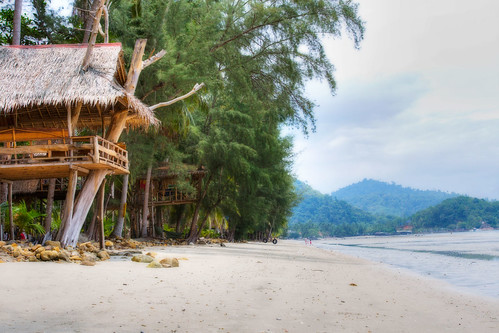
        The coastlines of the Koh Chang Marine National Park is a spectacular work of nature’s art and there are beautiful beaches, coves and bays around the islands. Koh Chang Marine National Park is indeed a wonderland of fertile virgin rainforests, untrekked jungles, high peaks, breathtaking waterfalls, beautiful beaches, spectacular coastlines, colourful coral reefs, clear blue sea of warm waters, idyllic islands, fascinating wildlife and an abundance of healthy marine life. All waiting to be discovered.


        Realising the rich tourism resources and the economic potential of the Koh Chang Marine National Park, plans are being carefully mapped out to open up more doors and windows to welcome environmentally-conscious visitors who can appreciate this forgotten paradise of leisure islands. Koh Chang Marine National Park is set to be the new holiday destination within an old natural Marine National Park. Soon it will be a secret no more.


Be the first to discover the secret wonders of Koh Chang Marine National Park.


koh-chang.com