Monday, March 1, 2010

KOH SAMET of Thailand


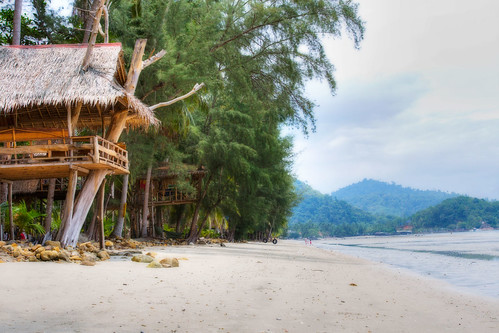
        Welcome to one of Thailand's hidden jewels: The island of Koh Samet. This beautiful island has it all: superb beaches, lovely coral reefs, excellent dining and an atmospheric night life.


         Less than seven kms off the coast of Rayong Province in the eastern Gulf of Thailand, it combines the allure of a tropical paradise with reasonable proximity to Bangkok. Koh Samet has been known as a safe anchorage for sailors since at least the 13th century and in the 19th century its sheer beauty was the inspiration for the literary masterpiece of Thailand's most famous romantic poet, Sunthorn Phu.

 
         Koh Samet was once mostly for well to do Thais and local Thai tourists, but as travelers from far and wide started hearing talk of the paradise island with the smooth white beaches - things started changing. Today Koh Samet offers a variety of accommodation starting with the excellent (and expensive) Paradee Resort & Spa over to more modest accommodations.


         Choosing where to stay

         It is often difficult to know just where to stay when visiting an island for the first time. Koh Samet is actually a very small island and regardless of which beach you stay by, you can easily get to the other beaches in less than 15 minutes. Generally speaking, most of the higher end resorts are located by Saikaew Beach, which is also the liveliest beach on the island. Ao Vongduan Beach is also popular, but most of the beaches offer a variety of choice and are good choices to stay at.


-

Welcome to "Songkran Day"


     Welcome to "Songkran Day" This is a Thai traditional New Year which starts on April 13th - 15th every year.


     Songkran is a Thai word which means "move" or "change place" as it is the day when the sun changes its position in the zodiac. It is also known as the "Water Festival" as people believe that water will wash away bad luck. The word Songkran comes from the Pali language of the Therevada Buddhist scriptures (Sankhara) and the Sanskrit word (Sankranti) for movement or change.


     In ancient times, it was celebrated as a moveable feast, and set to occur as the sun moved into the Aries portion of the zodiac. In modern times the date has been fixed as April 13.


     Although the Thai people officially changed the New Year to January 1 in 1940 to coincide with the Western business world, the traditional Songkran Festival is still celebrated as a national holiday in Thailand.


     The festival lasts for 4 days. Maha Songkran Day is the first day of the celebrations which marks the end of the old year. April 14, Wan Nao is the day between the ending of the old year and the beginning of the new year when foods are prepared for the temples. The third day of Songkran, April 15, is Wan Thaloeng Sok - the day on which the New Year begins and on the last day, Wan Parg-bpee, the ancestors and elders are honored.


     - World's Biggest Water Fight -

     Khao San Songkran Festival


     The Songkran Festival shares some similarities with the Holi festival in India celebrated around the same time. One custom that Songkran shares with Holi is the releasing of small fish back into the rivers and steams. In Thailand, small birds may also be released from cages as part of the festivities.


     While in India the throwing of colored water marks Holi, the Thai Songkran Festival involves throwing clear water - and lots of it! - although many add colored powders and scents to the water in Thai New Year celebrations in playful "water wars."

     The tradition traces back to the pre-Buddist rituals of spring festivals where the throwing of water was meant as a symbol of luck to bring good rain for the crops. It was later converted to the religious custom of cleansing the statues of Buddha once a year. In many places there are parades with the statues of Buddha and as the parades pass, crowds shower the Buddha with water.


     Pouring small amounts of scented lustral water on the heads of the elders on Wan Parg-bpee as a sign of respect is also part of this custom. In many temples throughout Thailand people bring sand to symbolically replace the sand that they have carried away on their sandals throughout the year. The sand is formed into pagodas called phra chedis sai and decorated with colorful flags as part of the Songkran New Year festivities. It may be that this tradition began as part of the cleansing rituals where new, clean sand was added to the floor of the temple once a year.


     The foods that are served at traditional Songkran Festivals depend on the part of Thailand you visit. Pad Thai Noodles; Khao Chae, a delicious rice dish; Gaeng Kiew Wahn Gai, chicken with green curry; krayasad, a mixture made from puffed rice, oats, peanuts and Thai noodles that is sweetened with palm sugar and coconut syrup; Kanom Tom, sticky rice and mung bean balls piled high into a pyramid shaped dessert and Kanom Krok, coconut rice pancakes are some of the more universal Thai foods enjoyed during the Songkran festival.


-

Saturday, February 27, 2010

THE SECRET WONDERS OF THE KOH CHANG


      Koh Chang Marine National Park is new and virtually unknown to the outside world. Few people know of its secret wonders. Some even boldly call it “the last paradise islands in South-East Asia”. A paradise it is, Koh Chang Marine National Park has been a heaven to the locals who need to replenish their mind and energy, to recharge.

    Koh Chang is the largest of the 52-island Marine National Park, all of which are untouched by modernization with their natural resources kept intact. Thus, qualifying the park as a dream escape, a true hideaway, far from the bustling city-life. But in fact, Koh Chang is only 330 kilometers east of Bangkok or approximately 4 hours by road plus another 30 to 45 minutes by boat or ferry.


      It is surprising even to the Thais that Koh Chang is actually the second largest island in the whole of Thailand, behind Phuket. Despite its size and close proximity to the capital, Koh Chang is least known, undeveloped, untouched, forgotten, and left idle for decades. No doubt, all these are a blessing in disguise.


        Koh Chang Marine National Park is a secret retreat yet to be explored. Nearly 75% of the Marine Park is protected by law, under the jurisdiction of the Forestry Department of Thailand. This explains how it remains a virtual virgin wonderland shielded from devastating and vigorous developments. Hence, the lack of infrastructure and population.There are few thoughts of modernization.

       The locals as well as their regular patrons are pleased the way it is. So, slow and gentle, tranquil and romantic, Koh Chang Marine National Park continues at its own pace, and still, a paradise for those who appreciate nature at its basics more than the sophisticated luxury of modernity.


        The coastlines of the Koh Chang Marine National Park is a spectacular work of nature’s art and there are beautiful beaches, coves and bays around the islands. Koh Chang Marine National Park is indeed a wonderland of fertile virgin rainforests, untrekked jungles, high peaks, breathtaking waterfalls, beautiful beaches, spectacular coastlines, colourful coral reefs, clear blue sea of warm waters, idyllic islands, fascinating wildlife and an abundance of healthy marine life. All waiting to be discovered.


        Realising the rich tourism resources and the economic potential of the Koh Chang Marine National Park, plans are being carefully mapped out to open up more doors and windows to welcome environmentally-conscious visitors who can appreciate this forgotten paradise of leisure islands. Koh Chang Marine National Park is set to be the new holiday destination within an old natural Marine National Park. Soon it will be a secret no more.


Be the first to discover the secret wonders of Koh Chang Marine National Park.


koh-chang.com

Wat Phra That Lampang Luang


       About 20 kilometers from Lampang is the old temple of Wat Phra That Lampang Luang. On first glance, this walled citadel sited on a man-made mound of earth has a very fortress-like look to it. That's because the temple was built on the site of an eighth century fortification, called a wiang, that guarded the routes to Lampang.


       The temple buildings seen today were built in the fifteenth century, and one of the reasons for the temple's popularity is the relatively pure state of all the temple buildings. Unlike most of the temples in Chiang Mai, Wat Phra That Lampang Luang hasn't been 'improved' to conform to modern Thai ideas about temples. The courtyard is still filled with sand, and the huge main wiharn (prayer hall) is still open on all sides.
  
        To enter the temple, you must pass a pair of guardian lions and climb the naga stairway up to the massive main gate. The main prayer hall, the Wiharn Luang, stands close inside the main entrance. The wiharn is open on all four sides, forming a huge covered hall. Sturdy columns support the roof. The columns are finished in black lacquer and stenciled with gold leaf designs.


      At the back of the Wiharn Luang sits a massive gilded ku, a sort of Laotian prang sheltering the main Buddha image. The Buddha image is the Phra Chao Lang Thong, cast in 1563. On either side of the Ku are throne-like pulpits, sometimes used by monks but more often used to house other Buddha images on important ceremonial days.


       Behind the main prayer hall stands the 45 meter tall chedi. The chedi was faced with copper and bronze sheets, which over the centuries have oxidized into a variety of green and blue shades. The chedi has somehow escaped the gilding which is now universally applied to chedis, even if they weren't originally built that way.


         Flanking the chedi on the south side is another prayer hall, the Wiharn Phra Phut, a small chapel built in 1802 with a beautifully carved fascade. Behind the Wiharn Phar Phut is a tiny tower-like structure, the Ho Phra Phuttabat. It houses a Buddha footprint sculpture. The building is generally only open on important festival dates, and may never be entered by women.

         On the other side of the chedi and the main wiharn are two other small open chapels. Although very weathered, both have some rather interesting details and murals.

         A doorway on the south side of the gallery leads you to several other buildings, as well as the temple's museum. On the way, you'll pass an ancient bodhi tree whose branches are supported by a forest of crutches.
        The two museums are not very interesting, even though one houses the Phra Kaeo Don Tao, a supposed 'copy' of the Emerald Buddha and made at the same time. But it lack most of the subtlety of the Emerald Budda, and the setting doesn't do it justice. For a close-up look at the Emerald Buddha, you're better advised to visit Wat Phra Kaeo in Chiang Rai, where they have a recently made copy in a beautiful setting. However, there is a beautiful 400 year old scripture library in amongst the museums that is worth a look.


Knowledge : http://www.tlcthai.com/webboard/view_topic.phptable_id=1&cate_id=66&post_id=70913


Phukradung National Park in Thailand


        Accommodation on Phukradung National Park located at Wang Kwang Visitor Centers; far from Mountain top about 3 kilometers. Tourist can choose which style do you want; tent or house but tourist has to contact the official in advance.


        At Phukradung National Park visitor center, it has guesthouse about 10 houses which can stay 8 persons per house and big guesthouse which can stay 30-40 persons per house moreover it has many permanent tents which can stay 2 persons per tent.


        If you bring your tent you can set your tent at wide grassland and it has blanket and pillow for hire also. You have to pay for set up tent fee on grassland about 30 THB per night per person and blanket 10 THB per one per night.


        Accommodation list on Phukradung National Park
1. Nagaratch, Son Sai and Sampao Ngern (นาคราช, สนทราย, สำเภาเงิน)Each house has 3 rooms, 2 toilets, stay 12 persons and pay 3600 THB per night per house.
2. Salium Dong, Ampawa, Suphannika, Song Badan, Sai Nampheung and Lamduan Dong (เสลี่ยมดง, อัมพวา, สุพรรณิการ์, ทรงบาดาล, สายน้ำผึ้ง, ลำดวนดง)Each house has 2 rooms, 1 toilet, stay 8 persons and pay 2400 THB per night per house.
3. Yad Namkhang (หยาดน้ำค้าง)It’s like a townhouse has 4 rooms and each room has 1 toilet, stay 10 persons and pay 2000 THB per night per room or 8000 THB per house.

4. Kularb Khao (กุหลาบขาว)It has 3 rooms, 1 toilet, stay 6 persons and pay 1800 THB per night per house.

5. April (เอพริล)It has 2 houses and each house has 2 rooms, 2 toilets, stay 4 persons and pay 1600 THB per night per house.
6. Phaka Krong (ผกากรอง)This is accommodation located at foothill of Phukradung. It has 3 houses and each house has 1 room, 1 toilet, stay 4 persons and pay 1200 THB per night per room or 3600 THB per house.
7. Tien Nam (เทียนน้ำ)This is also like town house has 5 rooms; each room can stay 6 persons and pay 900 THB per night per room but have no toilet.

8. Permanent tent (Already set up)It has 200 tents for stay 2 persons per tent, pay 200 THB, for 3 persons per tent, pay 250 THB and for 4 persons per tent, pay 300 THB.

9. Tent for hire (You have to set up by yourself)It has 400 tents, stay 2 persons per tent and pay 100 THB per tent.


Knowledge : http://phukradung-national-park.blogspot.com/

Friday, February 26, 2010

Wat Pho or Wat Phra Chetuphon


       Wat Pho or Wat Phra Chetuphon as it is generally known to the Thais, is mainly famous for the huge Reclining Buddha statue it houses. At 20 acres large, it is the largest Wat in Bangkok, and is technically the oldest too, as it was built around 200 years before Bangkok became Thailand's capital. However, today the Wat today bears virtually no resemblance to that originally constructed, as it was almost entirely rebuilt by Rama I when the capital was moved to Bangkok. It holds the dual honors of having both Thailand's largest reclining Buddha image and the most number of Buddha images in Thailand.


       The highly impressive gold plated reclining Buddha is 46 meters long and 15 meters high, and is designed to illustrate the passing of the Buddha into nirvana. The feet and the eyes are engraved with mother-of-pearl decoration, and the feet also show the 108 auspicious characteristics of the true Buddha.


        The large grounds of Wat Pho contain more than 1000 Buddha images in total, most from the ruins of the former capitals Ayuthaya and Sukhothai. The grounds are split in two by Chetuphon road. The northern section is generally the only one most people go to, and it includes a large bot (temple hall), enclosed by 394 bronze Buddha images. Outside the bot, there are 152 marble slabs depicting the second half of the epic Ramakian story.


         Also near here are four chedis, constructed to honor the first three Chakri kings (two for King Rama III). There are also a massive 91 others Chedis of varying sizes arounds the grounds, along with chapels, rock gardens, an array of different types of statues, inscriptions, belltowers and resident fortune tellers.

        The library is nearby too, decorated impressively with figures and pagodas made of porcelain, in much the same way as Wat Arun across the river. The much less visited southern section has less of interest, but makes a good place to find a monk to chat to for a while. Most would welcome the chance to practice their English on visitors.


http://www.into-asia.com/

Beautiful in 'Krabi'


      Krabi is situated on the south of Thailand. West of Krabi is the Andaman Sea. Krabi is abundant of sea- natural attractions. Find more Krabi geography. Koh Phi Phi seems to be more known than Krabi. Many international movies were made at Koh Phi Phi e.g. the Beach.


       To arrive at Krabi is very easy nowadays. You may fly, take a bus or train but stop at Suratthani, or even ferry boat from Phuket. Find how to get to Krabi.

       What are interesting places for a tourist like me?

       In addition to Koh Phi Phi, Ao Nang, Koh Lanta and Railay are well-known among European tourists. Recently, Tupkaek beach is gaining more popularity for tourists who would like to avoid the crowd from Ao Nang. Find more Krabi Attractions.

      What are we going to do in Krabi?

       Krabi is a popular place for sea kayaking at Tha Lane, Khao Nor Ju Jee, Koh Hong , Pranang Cave, Koh Phak Bia, etc. Rock climbing must be at Railay. Scuba diving and snorkeling at Koh Phi Phi or Koh Ngai or Koh Rok (near Koh Lanta). Find more activities in Krabi.

   
      How about nightlife in Krabi?

       Only food market, so called Talad Torung in Krabi Town, around Chao Fah road. You may find a local food with very cheap price from half hundred food shops. Unlike Aonang, you may find international food restaurants till the mid night. Phi Phi is a never sleeping spot, mostly found are beer bars. On the other islands e.g. Koh Ngai, Koh Mook, Koh Jum, Koh Libing, you won’t find any nightlife.


      Where will I sleep?

         There are many budget guesthouses to luxury hotels in all Krabi province. For anyone who would travel to the islands you have to book a room for at least 1 to 6 months in advance. Some destinations have only limited numbers of rooms and resorts e.g. Railay, Koh Mook and Koh Ngai.

         You may need to sleep on the beach unless you book in advance, especially during the high season: November to March every year. In Krabi town, you may find accommodation easilier if you walk around Chaofah Road. At Aonang, there are many newly open resorts and bungalows in sub-roads. You may hire songtaew (passenger pick-up car) or Tuk-Tuk and the driver will bring you around for accommodation.